What Is Food Safety Management System Software? (Features & Benefits)

Daria Van De Grift
Food safety compliance is increasingly more complex because food regulations are changing, customer demands are rising and the interdependency of food supply chains is getting bigger. Keeping records on paper or in separate spreadsheets can be cumbersome and challenging in terms of showing compliance, answering audits, and determining potential risks in a timely fashion. That is why there is an increasing uptake by many organisations of food safety management system software to simplify compliance programmes.
Food safety software enables food manufacturers, processors, distributors and other food businesses to document, oversee and track food safety activities, enhance traceability, and ensure regulatory compliance in a single centralised digital platform. You’ll learn what food safety management system software is, the essential features, the benefits it can provide and how to find the best food safety management system software for your organisation.
What Is Food Safety Management System Software?
It is a digital solution designed to help food businesses manage the processes, records, and documentation required to maintain food safety and regulatory compliance.
Instead of relying on paper-based systems, manual spreadsheets, or disconnected files, organisations can use software to centralise their food safety activities within a single platform.
Depending on the business and its operational requirements, the software may support:
- Food safety documentation
- HACCP programmes
- Supplier management
- Internal audits
- Corrective actions
- Training records
- Document control
- Risk assessments
- Traceability records
- Compliance reporting
The primary goal is to help organisations improve consistency, reduce manual work, and maintain accurate records that are readily available during customer, certification, or regulatory audits.
Why Businesses Are Moving to Digital Food Safety Software
Food safety regulations are still changing in the food sector.
Businesses need to have accurate and organised documentation to ensure compliance with certification standards, like SQF, BRCGS, FSSC 22000 and regulatory and customer requirements.
There are many benefits of having digital food safety software over the old method, which was facilitated using paper-based solutions.
Improved Document Organisation
Paper records may be scattered throughout and can be hard to locate and difficult to access.
The food safety management system software puts all the documents into a single system, including the following:
- Policies
- Procedures
- Work instructions
- Training records
- Audit reports
- Corrective actions
- Supplier documentation
Having information structured in a coordinated system reduces administrative efforts and facilitates access to it.
Better Version Control
A challenge in the case of paper documentation is making sure employees have access to or are using the most current, approved version at all times.
The following are kept up by digital systems:
- Change histories
- Approval procedures
- Document ownership
- Review schedules
- Archive management
This decreases the possibility that old versions of procedures will continue to be circulated.
Faster Audit Preparation
Preparing for food safety audits often requires gathering documents from several departments.
Using digital software allows authorised users to quickly access the following:
- HACCP documentation
- Internal audit records
- Supplier approvals
- Training logs
- Verification activities
- Corrective action reports
This can significantly reduce the time required to prepare for inspections.
Greater Visibility Across Operations
A centralised system enables managers to have greater insight into compliance within the entire organisation.
Management can track the status of documentation, outstanding actions and compliance trends more effectively, rather than examining paper files one at a time.
Core Features of Food Safety Management System Software
FEATURES differ between software providers, but most contemporary food safety management solutions have a baseline of capabilities.
Document Control
Good document control underpins every food safety management system.
Centralised Document Storage
Food safety software enables organisations to keep all of their controlled documents in a single secure location.
This may include:
- Food safety manuals
- Standard operating procedures
- HACCP plans
- Work instructions
- Policies
- Forms
- Records
Centralised storage also minimises duplication and makes information easier to access.
Version Management
There must be a controlled life cycle for each document.
Software often includes the following:
- Version numbering
- Approval tracking
- Revision history
- Document review reminders
- Archive functionality
These features help keep procedures current and employees working from up-to-date documentation.
User Permissions
Not every employee requires access to every document.
Most systems allow administrators to control permissions based on:
- Department
- Role
- Responsibility
- Management level
This improves security while protecting document integrity.
HACCP Management
Hazard Analysis and Critical Control Point (HACCP)-based programmes are fundamental to many food safety systems.
Software can make it easier to manage HACCP paperwork.
Hazard Analysis
With digital systems, companies can track:
- Biological hazards
- Chemical hazards
- Physical hazards
- Allergen hazards
- Preventive controls
Maintaining a hazard analysis in an organised manner facilitates continuous re-evaluation and improvement.
Critical Control Points
Many platforms allow businesses to document:
- Critical limits
- Monitoring activities
- Verification procedures
- Corrective actions
- Validation records
This provides a structured approach to managing food safety controls.
Internal Audit Management
Regular internal reviews enable an organisation to uncover problems in its processes before they are discovered by external auditors.
Audit Procedures
Food safety management system software may have scheduling features to assist in planning the following:
- Internal Audits
- Site visits
- GMP inspections
- Supplier audits
- Follow-up assessments
Audits are more likely to be completed on time when these reminders are automated.
Audit findings
This allows auditors to note while they are on-site:
- Observations
- Non-conformities
- Opportunities for improvement
- Evidence
- Corrective actions
Consolidating audit documentation to one system makes it easier to track trends over time.
Corrective and Preventive Action (CAPA) Management
Food businesses regularly identify issues requiring corrective action.
Rather than managing these manually, software provides structured workflows.
Corrective Action Tracking
Organisations are able to log the following details:
- Root cause investigations
- Immediate containment actions
- Corrective actions
- Responsible personnel
- Completion dates
- Verification activities
This is more accountable, and we support continuous improvement.
Preventive Actions
Not only can they help solve current problems, but software can also allow companies to track oncoming patterns and take preventive actions before the damage is done.
The availability of records for both corrective and preventive actions demonstrates a positive initiative towards food safety management.
Additional Features of Food Safety Management System Software
Beyond document control and HACCP management, modern food safety management system software includes a wide range of tools that help organisations maintain compliance more efficiently.
Supplier Management
Suppliers are key in ensuring food safety. Outdated supplier details or certifications could lead to unnecessary risk of non-compliance.
Supplier Approval
There are plenty of options when it comes to food safety software systems to help companies keep their approved suppliers in an organised list.
Typical supplier records include the following:
- Company information
- Food safety certifications
- Product specifications
- Allergen declarations
- Risk assessments
- Approval status
It all adds up to make supplier evaluations simpler and purchasing decisions better informed if that information is a click away.
Supplier Performance Monitoring
Supplier management doesn’t end after approval.
Organisations can use software to help track the following:
- Expiry dates of certifications
- Supplier audits
- Non-conformities
- Customer complaints
- Corrective actions
- Continuing supplier performance
This enables continuous supplier assessment and product chain enhancement.
Training Management
Every food safety management system relies on employees who are well-trained.
Digital software simplifies the coordination of training programmes over various departments.
Training records for employees
Businesses can keep them rather than maintaining the files on paper.
- Training attendance
- Competency assessments
- Refresher training
- Role-specific qualifications
- Food safety qualifications
Employee documentation is easier to access in a centralised record during an audit.
Training Schedules
Many systems provide reminders when refresher training is due.
This helps organisations maintain staff competency and reduce the risk of missed training deadlines.
Traceability and Recall Support
Fast and accurate traceability has become increasingly important for food businesses.
Product Traceability
Many food safety management system software platforms help organise records relating to:
- Raw materials
- Finished products
- Production batches
- Lot numbers
- Supplier information
- Customer shipments
Improved record organisation supports quicker investigations when issues arise.
Recall Documentation
If a recall becomes necessary, having organised documentation can significantly improve response times.
Software may assist with:
- Recall procedures
- Contact lists
- Product tracking
- Investigation records
- Corrective actions
- Communication logs
Although software does not prevent recalls, it can support a more efficient and documented response process.
Reporting and Analytics
Reliable reporting helps management evaluate the effectiveness of food safety programmes.
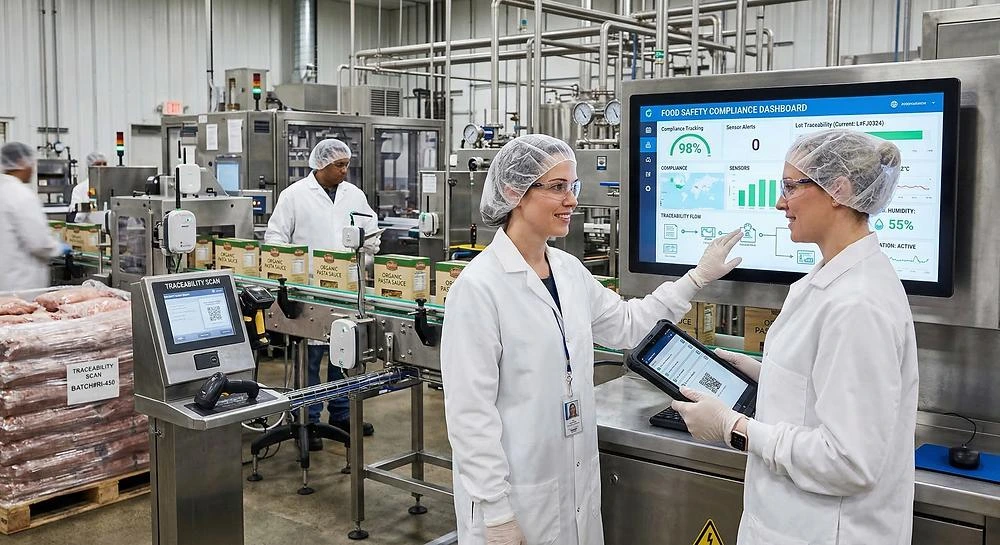
Compliance Dashboards
Many systems provide dashboards displaying information such as:
- Outstanding corrective actions
- Upcoming audits
- Training completion rates
- Document review status
- Supplier approvals
- Risk assessments
These dashboards provide greater visibility across compliance activities.
Trend Analysis
Over time, organisations can analyse trends involving:
- Audit findings
- Customer complaints
- Supplier performance
- Corrective actions
- Internal inspections
Identifying recurring issues allows management to focus improvement efforts where they will have the greatest impact.
Benefits of Food Safety Management System Software
Implementing food safety management system software offers benefits beyond simply replacing paper records.
Improved Compliance
Keeping orderly records also enables businesses to more consistently prove compliance with food safety standards and legislation.
The software enables control processes to be structured and manages the risk of losing any documentation on audits.
Improved Operational Efficiency
Administrative activities are also time-consuming.
With its combined ability to centralise records, automate reminders and facilitate document retrieval, the result is less manual administration and more team focus on food safety activities.
Better Audit Readiness
Preparation for audits is made simpler when records are already filed in a controlled environment.
Instead of rifling through file cabinets or spreadsheets, authorised users can instantly access paperwork auditors want.
This may reduce stress and increase audit efficiency.
Stronger Document Control
Version control, approval workflows and revision tracking ensure that your employees are always working according to the latest procedures.
Good document control eliminates confusion and helps to keep processes uniform.
Improved Collaboration
Food safety responsibilities often involve multiple departments, including:
- Quality Assurance
- Production
- Purchasing
- Maintenance
- Warehouse
- Management
Digital systems improve collaboration by allowing authorised users to access current documentation while maintaining appropriate security controls.
Reduced Risk of Human Error
Manual record-keeping increases the likelihood of:
- Missing records
- Incorrect versions
- Lost paperwork
- Forgotten review dates
Automation and digital workflows help minimise these risks while improving overall consistency.
Who Should Use Food Safety Management System Software?
Although food safety software is commonly associated with manufacturers, many organisations across the food supply chain can benefit from digital compliance management.
Typical users include:
- Food manufacturers
- Food processors
- Packaging companies
- Ingredient suppliers
- Warehousing operations
- Cold storage facilities
- Food distributors
- Importers
- Exporters
- Co-manufacturers
- Contract packers
Businesses of all sizes can benefit from improved organisation, stronger document control, and simplified compliance management.
How to Choose the Right Food Safety Management System Software
Not all software systems are equally capable.
Selecting a solution is more about what your operational business needs are than just deciding what software has the best set of features.
Food Safety Considerations
Start with Which Elements of Your Food Safety Management Require the Most Support Identify the areas where your food safety management system needs the most assistance.
For example, your priorities in your organisation might be the following:
- Document control
- HACCP management
- Supplier management
- Internal auditing
- Training management
- Corrective action tracking
Traceability
If you have a clear idea of your priorities, the decision process will be easier.
Check out the ease-of-use factor
Compliance is best when it’s simple, not when it adds another layer of complexity to compliance.
Search for Features Such as:
- Simple to navigate
- Workflows that are logical
- User-friendly dashboards
- Simple document management
- Simple search features
Employee-friendly systems tend to be more successful when they are implemented organisation-wide.
Consider Scalability
As your business expands, so should your compliance system.
Use software that can accommodate:
- Additional facilities
- Additional users
- Alternative product lines
- Changing compliance requirements
Changes in rules may require waivers/authorisations for documentation from the government under the revised documentation requirements.
Scalable systems prevent the need for expensive software modifications later down the road.
Consider Support and Services for the Implementation
The degree of support can often determine the success of the installation. Think about whether the vendor provides:
- Help with implementation
- Training materials/resources
- Customer service/support
- Continual updating
- Knowledge of regulatory issues
Good implementation support may enable organisations to realise the full value of their software investment over the long term.
Why Choose Document Compliance for Food Safety Management Solutions?
The installation of food safety management system software is, however, just part of the story when it comes to creating an efficient food safety programme. Good documentation and processes, along with professional advice, will also be crucial to success to get your system in line with food-safe recognised standards and ensuring that operational needs are met.
At Document Compliance, we provide practical document solutions to the food industry, assisting food businesses to enhance their compliance programmes, develop food safety systems and more. Good food safety software can be very effective in processing well-maintained documentation.
We assist companies in creating and maintaining critical documents such as the following:
- Food Safety Manuals
- HACCP documentation
- SOPs (Standard Operating Procedures): To ensure a consistent quality and safe product and to standardise your procedures, we help you develop SOPs for daily operations.
- Risk assessments
- Supplier approval programmes
- Internal audit processes
- Corrective action records
- Food traceability documentation
These core records and documents underpin a robust food safety management system, enabling you to stay audit-ready all year long.
With well-organised records, efficient document control, and a systematic management approach, your company will have enhanced its readiness for auditing, regulatory inspections, and driving continual improvement.
Conclusion
Effective food safety management is more than just paperwork. They require dependable systems that enable compliance, enhance documentation control, increase traceability, and streamline routine food safety operations.
Food safety management system (FSMS) software can help you to centralise documentation, manage HACCP programmes, track corrective actions, manage supplier details, monitor employee training, and boost your audit preparedness. Instead of scattered manual procedures, organisations can introduce structured digital workflows to simplify processes and reduce burden while gaining heightened visibility into their food safety management system.
But software, in and of itself, does not ensure compliance. Good procedures, proper records, trained staff, and regular reviews of the system are still needed to run an effective food safety programme. If your organisation is seeking to boost compliance, reduce documentation burdens, and audit with greater confidence, the right combination of food safety software and expert compliance support will not only deliver long-term value – it can also help make your overall food safety culture stronger.
FAQ’s
Q1. What is food safety management system software?
Ans: Food safety management system software is a digital platform that helps food businesses manage documentation, HACCP programmes, supplier records, internal audits, corrective actions, training records, and other compliance activities within a centralised system.
Q2. How does food safety software improve compliance?
Ans: Food safety software helps organise documentation, strengthen document control, automate reminders, improve record accessibility, and support consistent implementation of food safety procedures, making it easier to demonstrate compliance during audits.
Q3. Is food safety management system software suitable for small businesses?
Ans: Yes. Many small and medium-sized food businesses use food safety software to improve document management, reduce paperwork, and maintain compliance more efficiently. The appropriate solution depends on the size and complexity of the operation.
Q4. Can food safety software replace HACCP?
Ans: No. HACCP remains a recognised food safety methodology for identifying and controlling hazards. Food safety management system software supports HACCP by helping businesses organise documentation, monitoring records, verification activities, and corrective actions.
Q5. What features should I look for in food safety software?
Ans: Important features may include:
- Document control
- HACCP management
- Internal audit management
- Supplier management
- Corrective action tracking
- Employee training records
- Traceability support
- Reporting and analytics
- User permissions
- Version control
The right features will depend on your business requirements and applicable food safety standards.
Q6. Does food safety software help with certification audits?
Ans: Yes. While software does not guarantee certification, it can improve audit readiness by keeping documentation organised, maintaining revision histories, tracking corrective actions, and providing quicker access to records requested by auditors.
- [post_views]
- 0 Comments