Automated Supplier Compliance Tracking: The 2026 Guide to Audit Readiness

Daria Van De Grift
Automated supplier compliance tracking is a digital-first process that allows for automated gathering, verification, and tracking of expiration dates of vendor safety and regulatory documentation without relying on manual human effort. For the highly regulated food manufacturing and industrial sectors, these systems are replacing the ‘spreadsheet scramble’ by automating the notification engine, which helps keep every SQF certificate, Certificate of Insurance (COI), and W-9 current and verified. By using secure no-login links, Document Compliance Network (DCN) boosts supplier participation by 400% compared to a traditional password-protected portal.
The Hidden Costs of Manual Compliance Tracking
One of the problems many organizations face is the cost and workload associated with manually handling documents. If compliance is managed with Excel spreadsheets and email conversations, there are three main kinds of “hidden costs” at the facility.
The “QA Time Tax”
Between 10 and 15 hours a week on average is the time spent by the average QA manager doing clerical “paper chasing.A typical QA manager will spend 10 to 15 hours per week performing a clerical function called “paper chasing”.
This includes looking for missing documents and sending out manual follow-up emails, as well as cross-referencing expiry dates with a master spreadsheet. It’s a costly use of an extremely skilled worker’s time. These hours are automatically returned to the facility, enabling the QA team to direct their attention to improving the safety culture on the plant floor and optimize the processes instead of spending time on administrative data entry.
The danger of “Silent Expirations”
A “silent expiration” is when a supplier’s safety certificate or insurance policy expires without the manufacturer being aware of it. In a manual system, this is only identified at the time of an internal audit, or worse, during an unannounced SQF or FDA audit.
One missing or expired document can lead to a “Major” non-conformance, which can impact the facility’s certification and its opportunity to sell to major retailers. Using an automated “chase” engine, Document Compliance Network (DCN) removes the “silent expiration” problem by notifying vendors 90 days before the expiration date of documents.
Data Fragmentation and Security Risks
Manual systems often involve compliance documentation being distributed throughout individual email inboxes, on individual desktops and in physical filing cabinets. This disconnection prevents having one ‘true source of truth’ within the organisation. Moreover, documents such as W-9 forms that contain Taxpayer Identification Numbers (TINs) are also frequently transmitted via unencrypted email, leading to a high risk of cybersecurity exposure. With automated tracking, you can store this information in one location that’s both easily accessible and protected and encrypted.
Key Features of a High-Performance Automated Tracking System
A modern automated supplier compliance tracking system must be fast and easy for vendors to use to effectively outrank legacy approaches and the complicated “all-in” suite options.
Frictionless Data Collection (The DCN Advantage)
Portal fatigue is the No. 1 compliance challenge faced by compliance programs. Most enterprise systems demand that suppliers to create accounts, handle passwords and even go through training merely to upload a single PDF. Document Compliance Network (DCN) has a “no-login” method. Suppliers are provided with a safe, tokenized email link to be able to drag and drop their documents straight into the system. That’s what makes DCN consistently click with suppliers the most, without friction.
Intelligent Expiration Engines
In a truly automated system, you don’t have to wait for a document to expire in order to take action. It relies on a sequence of notifications, usually at 30, 60, and 90 day mark, to make sure that the renewal process is completed well before a gap would occur. The “chasing” will be done automatically by DCN, and if it does not get a response after a few attempted calls, will notify the QA manager.
Real-Time Compliance Dashboards
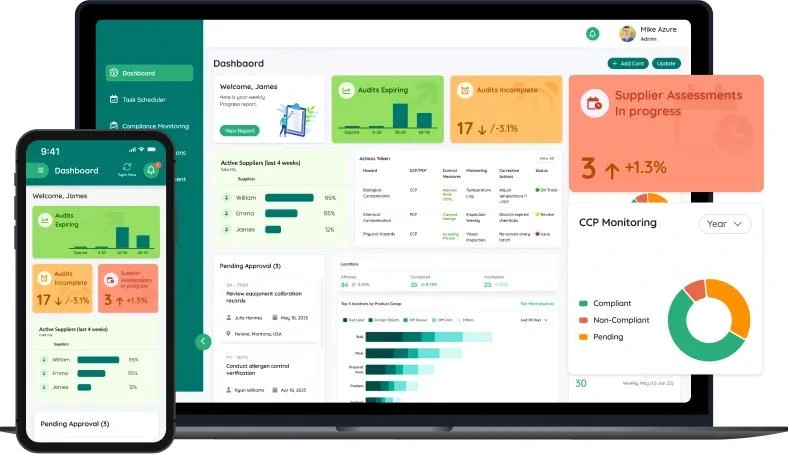
In an audit, being able to see where you’re compliant or not is a measure of confidence. A dashboard that offers the “Green/Yellow/Red” status for each supplier. This enables leadership to know exactly which vendors are compliant, which are going through the renewal process and which are high-risk. Document Compliance Network (DCN) delivers these visual insights in real-time, giving the facility a leg up on any audit.
Automated Supplier Compliance Tracking vs. Traditional Portals
| Feature | Manual Spreadsheets | Legacy Supplier Portals | Document Compliance Network (DCN) |
| Data Entry | 100% Manual | Supplier-led (with login) | Automated (No-login link) |
| Supplier Friction | Low (Email) | High (Password/Account) | Ultra-Low (One-click upload) |
| Expiration Alerts | None (Manual check) | Basic notifications | Automated 90/60/30-day “Chase” |
| Audit Readiness | Reactive “Scramble” | Module-dependent | Continuous/Instant |
| Implementation | None (Static) | 3–6 Months | 24–48 Hours |
Regulatory & Industry Standards Supported
Manufacturers looking to meet 2026 requirements are no longer seeing automated supplier compliance tracking as an “optional” efficiency, but as a regulatory requirement.
FSMA 204 and Traceability
For specific foods, the FDA’s FSMA 204 rule calls for better record-keeping for traceability. This includes monitoring of “Key Data Elements” (KDEs) throughout the supply chain. The basic supplier documents used for this type of traceability are always checked and associated with the appropriate supplier profile through automated tracking.
GFSI Benchmarks (SQF, BRCGS, FSSC 22000).
Global Food Safety Initiative (GFSI) standards specify that the supplier approval process must be “systemic”. Auditors are not satisfied with seeing a pile of papers; they want to see the system used to keep those papers up to date. Document Compliance Network (DCN) is the “systemic proof” which the auditors seek, documenting a complete log of requests, approvals, and archiving.
Insurance and Financial Risk Management
Compliance doesn’t only apply to food safety. Also, manufacturers need to monitor Certificates of Insurance (COI) as a means of avoiding liability, and W-9 forms for tax purposes. These business-critical documents are tracked with the automated functionality of DCN along with safety certifications, giving the full picture of vendor risk.
The ROI of Automation: More Than Just “Passing the Audit”
The Return on Investment (ROI) to Document Compliance Network (DCN) comes in two forms: risk avoidance and speed.
Manual System: It can take two weeks of emails back and forth to on board a new vendor. DCN sends the automated request immediately and the “no-login” link enables the vendor to respond in a matter of minutes. This rate permits manufacturers to launch new products at an early time.
Food Recall: The average cost of a food recall is $10 million. Automated tracking serves as a high-value insurance policy against disastrous safety lapses by keeping unapproved or uninsured suppliers out of the facility.
Labor Reallocation: Facilities can save 40+ hours of clerical work per month and redirect their QA team to more impactful activities, such as enhancing sanitation procedures or performing more regular internal facility audits.
How to Implement Automated Tracking in 3 Steps
Making the switch to Document Compliance Network (DCN) should be as seamless as the software itself.
- Data Audit: Create list of approved suppliers and the documents they need to provide. Your vendor list will be uploaded to the system by DCN to start it.
- The “No-Login” Launch: DCN sends out the initial automated requests. Secure links are provided to suppliers and they immediately start uploading their SQF certs, COIs and W-9s.
- Real-Time Dashboard: Continuous Readiness. After this point, the DCN “chase” engine steps in, watching out for all expiration dates and keeping your repository 100% compliant.
Why Food Manufacturers Choose Document Compliance Network (DCN)
Document Compliance Network (DCN) is the preferred alternative to complex, bloated risk platforms. We focus on the one thing that matters most: getting the document. Our flat-rate pricing, unlimited user access, and commitment to a “no-login” supplier experience make us the most practical choice for manufacturers who need results, not more software to manage. We understand that in the food industry, “Audit Ready” isn’t a goal—it’s a requirement for staying in business.
FAQs
Q1. What is automated supplier compliance tracking?
Ans: It is the use of software to automatically request, collect, and track the expiration of vendor documents like safety certificates and insurance policies.
Q2. How does automation improve SQF audit scores?
Ans: Automation ensures that no document is ever expired or missing during an audit. It provides a time-stamped, “systemic” record of compliance that demonstrates total control to the auditor.
Q3. Why do suppliers hate traditional portals?
Ans: Suppliers often serve hundreds of customers. Managing a separate username and password for every customer’s portal is time-consuming and frustrating, leading to ignored requests.
Q4. Can DCN track insurance and tax forms too?
Ans: Yes. Document Compliance Network (DCN) is designed to track any document with an expiration or renewal date, including COIs, W-9s, business licenses, and sustainability certifications.
Q5. How long does it take to set up automated tracking?
Ans: Most DCN implementations are completed in 24 to 48 hours, as the system does not require complex IT integration or supplier training.
Q6. Is the data secure without a supplier login?
Ans: Yes. DCN uses secure, tokenized links that are unique to each request. This ensures that only the intended supplier can upload documents, providing enterprise-grade security without the friction of a password.
Stop the Paper Chase and Secure Your Supply Chain
The era of manual compliance is over. Document Compliance Network (DCN) provides the automated supplier compliance tracking you need to protect your brand and pass your next audit with ease. Our frictionless technology ensures that your documentation is always complete, your suppliers are always verified, and your team is always focused on safety—not spreadsheets.
[Schedule a Free Demo with Document Compliance Network (DCN) Today]
- [post_views]
- 0 Comments