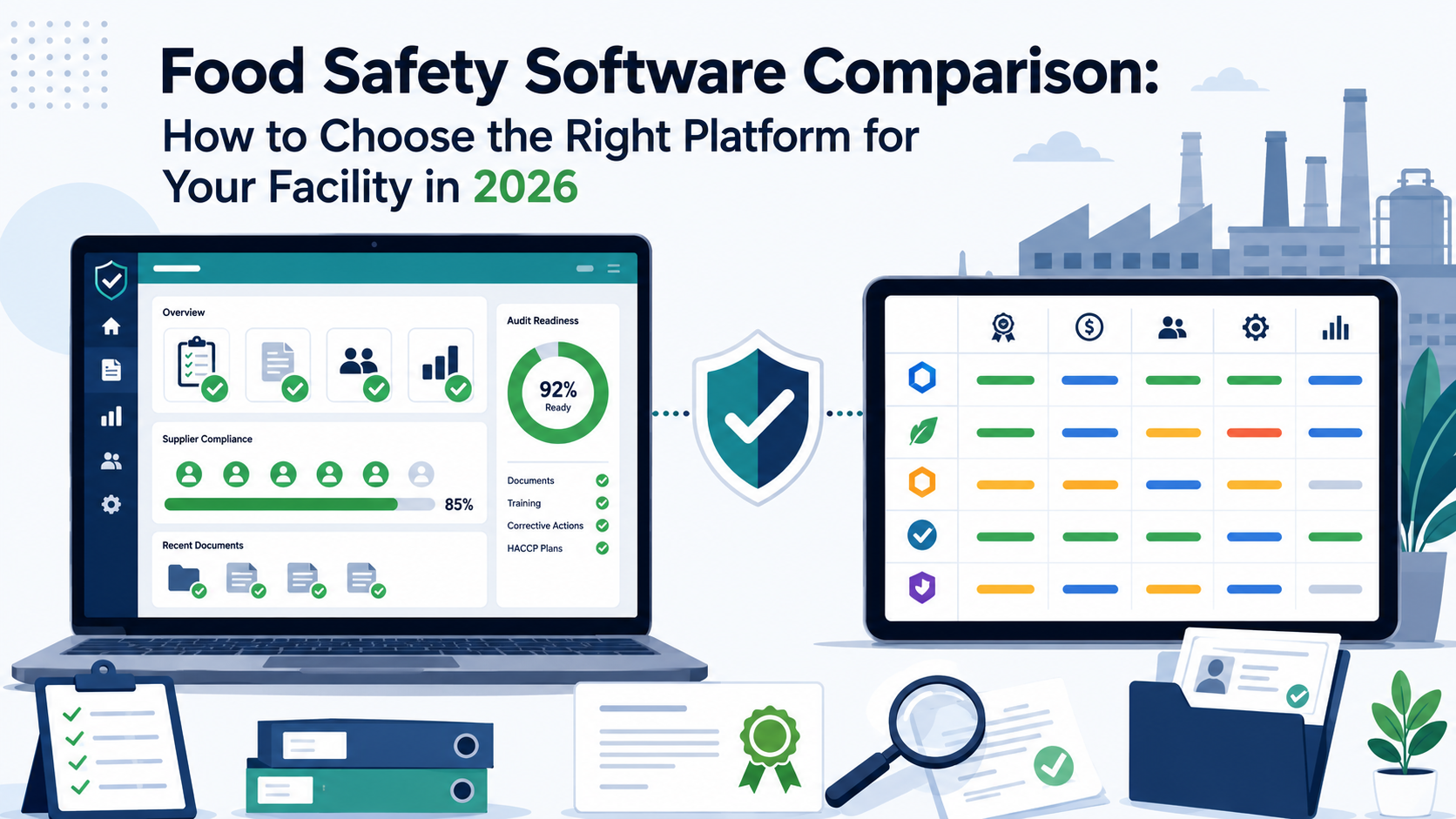
Food Safety Software Comparison: How to Choose the Right Platform for Your Facility in 2026

Daria Van De Grift
If you’re comparing food safety software right now, you’re probably dealing with one of these situations: your current system is a patchwork of spreadsheets, shared drives, and email chains that barely holds together during audits. Or you’ve outgrown a basic tool and need something that actually scales with your operation. Either way, you’re looking for a platform that keeps your documentation organized, your suppliers compliant, and your team audit-ready without the constant fire drills.
This food safety software comparison breaks down the five most relevant platforms for food manufacturers, processors, and distributors in 2026. We’ll walk through the features that actually matter, how pricing works across different models, common mistakes buyers make, and which platform fits which type of operation. No fluff, no hype, just a practical guide to help you make a confident decision.
According to Global Growth Insights, the global food safety HACCP software market reached $1.01 billion in 2026, driven by a 46% increase in digital compliance adoption across food processing and a 39% expansion in cloud-based HACCP deployments. Yet roughly 35% of small and mid-sized food enterprises are still transitioning away from manual safety systems, meaning the companies that digitize now gain a measurable competitive advantage in audit readiness and operational efficiency.
What Is Food Safety Software?
Food safety software is a digital platform that centralizes the documentation, workflows, and compliance processes food businesses need to meet regulatory requirements and pass third-party audits. It replaces paper logs, spreadsheets, and disconnected file systems with a single system where HACCP plans, supplier certifications, SOPs, corrective actions, training records, and audit documentation live in one searchable, version-controlled environment.
The best food safety management software doesn’t just store documents. It automates the collection and renewal of supplier records, tracks expiration dates, maintains audit trails, generates compliance reports, and keeps your facility in a state of continuous readiness rather than the typical pre-audit scramble.
Food safety software generally falls into two categories. Some platforms focus on plant-floor data capture: digital forms, temperature monitoring, real-time inspections, and production quality control. Others focus on the documentation backbone: supplier document management, SOP control, certification tracking, and audit preparation. A few try to do both. Understanding which category your facility needs most is the first step in making the right choice.
Check this pdf: Food_Safety_Software_Checklist_2026
Why Companies Are Replacing Paper-Based Compliance Systems
Paper-based food safety systems fail in three predictable ways: they can’t scale, they can’t be searched quickly during an audit, and they depend entirely on someone remembering to follow up.
When an FDA inspector or a BRCGS auditor asks for a specific supplier certificate, a corrective action log from six months ago, or proof that your HACCP plan was reviewed on schedule, the answer needs to come in minutes, not hours. Facilities running on paper binders and email threads routinely lose hours during audits tracking down records that should be instantly accessible.
According to the Food and Drug Law Institute (FDLI), the FDA issued an average of 51 warning letters per month in 2025, up from 47 per month in 2023, a trajectory that continued into 2026. Warning letters are issued on average 124 days after an inspection, and from 2019 to 2023, the rate of warning letters per 100 inspections increased 43%. The FDA has also deployed an internal AI system called “Elsa” that uses predictive analytics to prioritize high-risk facilities for inspection based on adverse event reports and historical inspection outcomes. Facilities running on paper-based compliance systems face significantly longer inspection timelines and higher rates of Form 483 observations compared to those using digital document management.
Beyond audit readiness, manual systems break down as operations grow. Adding new suppliers, onboarding new products, expanding to additional facilities, or transitioning between certification standards (say, from SQF to BRCGS) turns a manageable filing system into an unmanageable one. Digital food safety compliance software eliminates these bottlenecks by automating the repetitive work and creating a single source of truth.
The regulatory environment is also tightening. The FDA’s FSMA Section 204 traceability rule, with an enforcement deadline of July 20, 2028, requires electronic record-keeping capabilities that paper systems simply cannot support. Companies handling foods on the FDA’s Food Traceability List must maintain detailed records of Critical Tracking Events and Key Data Elements, and provide them to the FDA within 24 hours upon request. Companies that haven’t digitized yet are running out of runway. For a breakdown of what this means for your facility, see DCN’s guide on new FDA traceability rules.
According to Sedgwick’s U.S. Product Safety and Recall Index, food recalls reached 57.4 million units in Q1 2026 alone, nearly double the 28.76 million units recalled in Q4 2025. The FDA issued 251 food and beverage recall events in 2025, roughly five recalls every week. Undeclared allergens were the leading cause, accounting for 57 FDA food recall events in Q1 2026. Many of these recalls stem from documentation and labeling failures rather than manufacturing defects, which is exactly the kind of preventable gap that food document management software is designed to eliminate.
Who Needs Food Safety Software?
Any business that handles, processes, manufactures, stores, or distributes food products can benefit from food safety software. But the need becomes urgent for organizations in specific situations:
- Food manufacturers and processors managing HACCP plans, preventive controls, and GFSI certifications (SQF, BRCGS, FSSC 22000)
- Distributors and co-packers tracking supplier documentation across dozens or hundreds of vendors
- Packaging companies maintaining BRCGS Packaging Materials certification
- Multi-site operations that need consistent compliance standards across every facility
- Companies preparing for or maintaining SQF, BRCGS, or FSMA compliance where documentation gaps create direct audit risk
- Quality managers and QA directors who spend more time chasing documents than improving food safety systems
If your QA team spends more than 10 hours per week on manual document management, or if your last audit surfaced documentation gaps that could have been prevented with better systems, it’s time to evaluate food compliance software.
Key Features to Compare
Not every food safety platform covers the same ground. Here are the features that matter most when making a food safety software comparison, and what to look for in each one.
Document Control and Version Management
Document control is the foundation of food safety compliance. Every SOP, HACCP plan, policy, and work instruction needs to be the current approved version, with a complete audit trail showing who changed what and when. Look for platforms that offer automatic version control, approval workflows, and the ability to retire outdated documents so they can’t accidentally be used on the production floor.
Platforms like Document Compliance Network build their entire architecture around document control, with immutable audit trails and version histories that satisfy BRCGS, SQF, and FSMA requirements out of the box.
Supplier Management
For most food businesses, supplier documentation is the single biggest compliance headache. COAs, allergen declarations, organic certifications, Kosher certificates, insurance documents, and food safety certifications all expire on different schedules. Tracking them manually across 50 or 200 suppliers is a full-time job.
The best supplier compliance tools automate the entire cycle: they send renewal requests to suppliers before documents expire, allow suppliers to upload directly without logging into a portal, and flag gaps in real time so nothing slips through the cracks. For a step-by-step process, see DCN’s supplier audit checklist.
Traceability
Food traceability software tracks ingredients, lots, and finished products across the supply chain from receipt through distribution. In a recall scenario, the difference between identifying affected product in minutes versus days can mean the difference between a controlled response and a crisis. With the FSMA 204 enforcement deadline set for July 20, 2028, lot-level traceability with linked documentation is becoming a baseline requirement.
HACCP and Food Safety Plan Management
Your HACCP software should store and manage the complete food safety plan: hazard analysis, critical control points, monitoring procedures, corrective actions, and verification records. Look for platforms that link monitoring records directly to the HACCP plan and make the entire system accessible during an audit without digging through folders.
Corrective and Preventive Actions (CAPA)
When something goes wrong, your system needs to capture what happened, what was done, the root cause, and what preventive measures were put in place. CAPA workflows built into the software create the closed-loop documentation auditors look for.
Audit Management
Good audit management lets you schedule internal audits, assign tasks, track findings, and generate reports demonstrating continuous improvement. The ability to pull up any record within seconds makes a measurable difference in how smoothly certification audits go.
Training Records
Every GFSI standard requires documented evidence that employees have been trained and assessed. Quality management software for the food industry should track training assignments, completion dates, competency assessments, and retraining schedules.
Digital Forms and Mobile Access
Plant-floor teams need mobile-friendly digital forms for inspections, temperature logs, cleaning records, and production checks. Look for platforms that work on tablets and smartphones, ideally with offline capability so data capture doesn’t depend on a Wi-Fi connection in every corner of the facility.
Automated Workflows
Automation is what separates software that saves time from software that just moves paperwork to a screen. The most impactful automations include expiration alerts, supplier document requests, approval routing, escalation notifications, and scheduled report generation.
Cloud vs. On-Premise Deployment
Cloud-based food safety software is the standard in 2026. It eliminates on-site servers, provides automatic updates, enables remote access, and scales easily. On-premise deployment still suits organizations with strict data sovereignty requirements, but comes with higher IT overhead.
Integrations
Check whether the platform integrates with your existing ERP, production management, or inventory systems. Data flowing between systems automatically reduces duplicate entry and ensures consistency.
Reporting and Analytics
Compliance dashboards, supplier performance reports, and expiration summaries help QA teams move from reactive firefighting to proactive management. The best platforms generate audit-ready reports with a single click.
Security
Food safety records are sensitive business documents. Look for SOC 2 compliance, role-based access controls, encrypted data storage, and FDA 21 CFR Part 11 support for electronic signatures and digital records.
Pricing Models
Food safety software pricing falls into four general models:
| Pricing Model | Typical Range | Best For |
|---|---|---|
| Flat-fee / unlimited users | $500 to $1,500/month | Mid-size operations wanting cost predictability |
| Per-user pricing | $15 to $50/user/month | Small teams with limited users |
| Per-facility pricing | $500 to $2,000+/facility/month | Multi-site enterprises |
| Quote-based / enterprise | Custom | Large, complex operations |
Hidden costs to watch for include implementation fees, per-supplier charges, data migration costs, and premium support tiers. Flat-fee models with unlimited users and documents, like the one offered by Document Compliance Network, tend to offer the most predictable total cost of ownership for growing operations.
Implementation Time
Implementation timelines range from same-day setup for simpler platforms to 3 to 6 months for enterprise deployments. Ask specifically about supplier onboarding time, since getting vendors to participate is often the real bottleneck. Platforms that let suppliers upload documents via simple email links rather than requiring portal registrations see significantly faster adoption rates.
Customer Support
During your first audit season with a new platform, responsive customer support is critical. Evaluate whether support is included in the base price or charged separately, whether it’s US-based or offshore, and whether you’ll have a dedicated account manager or rely on ticket-based support.
Top Food Safety Software Solutions (2026 Comparison)
Here’s a practical comparison of five platforms that serve different segments of the food safety software market. Each has genuine strengths, and the right choice depends on your facility’s size, certification requirements, and operational priorities.
Document Compliance Network (DCN)
Document Compliance Network is a cloud-based food safety compliance platform built specifically for food manufacturers, processors, and distributors managing SQF, BRCGS, FSMA, and HACCP requirements. DCN’s core strength is automating the document management backbone of food safety compliance: supplier document collection, internal SOP control, certification tracking, and audit preparation.
Best for: Mid-size food manufacturers and processors that need automated supplier document management, continuous audit readiness, and a system their suppliers will actually use.
Key strengths:
- Automated supplier document requests with email-based uploads (no portal logins for suppliers)
- Unlimited users, unlimited documents, unlimited vendors on flat-fee pricing ($12,500/year)
- Real-time compliance dashboard showing missing, expiring, and expired documents
- Immutable audit trails and version control meeting FDA 21 CFR Part 11 requirements
- Supports SQF, BRCGS, FSSC 22000, FSMA, and HACCP documentation
- Same-day setup for supplier module; full onboarding typically within days
- US-based customer support with dedicated account management
- iPad app for digitized production floor forms and HACCP logs
Considerations:
- Focused primarily on document compliance and supplier management rather than plant-floor IoT or real-time production monitoring
- Not a full ERP or production management system
Why it stands out: DCN’s supplier adoption rate is 4x faster than industry averages because suppliers upload via email rather than logging into a portal. For QA teams that spend significant time chasing supplier documents, this single feature can reclaim hundreds of hours annually. Learn more about DCN’s compliance workflow automation.
SafetyChain
SafetyChain is an enterprise-grade digital plant management platform focused on real-time data capture from the production floor, used by over 2,500 facilities including Tyson Foods.
Best for: Large food and beverage manufacturers with multiple facilities needing real-time production monitoring and plant-floor data collection.
Key strengths:
- No-code digital forms for inspections, quality checks, and audits
- Real-time statistical process control and production analytics
- Multi-facility deployment with centralized reporting
- Strong supplier management and compliance tracking
Considerations:
- Quote-based pricing, typically starting above $1,000/month per facility
- Implementation can take weeks to months
- May be more platform than smaller operations need
Why it stands out: SafetyChain is the heaviest-duty option for large-scale manufacturers unifying quality, safety, and production data across dozens of facilities.
Safefood 360°
Safefood 360° is a cloud-based food safety management system built for regulated food businesses needing deep HACCP, audit, and supplier management in a single platform.
Best for: Mid-to-large food manufacturers needing a comprehensive cloud FSMS with strong audit and supplier controls.
Key strengths:
- Complete FSMS covering HACCP, audits, CAPA, and document control
- Deep supplier quality management module
- Built-in audit scheduling, finding tracking, and corrective action workflows
- Supports SQF, BRCGS, and FSSC 22000
Considerations:
- Quote-based pricing with no published rates
- Longer implementation timeline than simpler platforms
- Interface complexity for teams new to digital food safety
- Supplier onboarding requires portal access
Why it stands out: Safefood 360° covers the widest range of food safety management functions in a single platform, making it strong for operations wanting everything under one roof.
FoodDocs
FoodDocs is an AI-powered food safety management system that generates HACCP plans and monitoring tasks automatically based on a short questionnaire. It’s designed for speed and simplicity.
Best for: Small to mid-size food businesses that need a fast, affordable way to digitize food safety documentation and daily monitoring tasks.
Key strengths:
- AI-generated HACCP plans and food safety documentation
- Setup in minutes with guided questionnaires
- 200+ free food safety templates
- Real-time dashboards and smart notifications
- Affordable per-location pricing (starting around $49/location/month)
- Mobile-friendly with offline capabilities
Considerations:
- Primarily designed for foodservice and hospitality; less purpose-built for manufacturing
- SQF, BRCGS, and FSSC 22000 coverage not explicitly documented for all use cases
- Supplier document management is not a core strength
- May lack the depth needed for complex manufacturing compliance
Why it stands out: FoodDocs is the fastest path from zero to a basic digital food safety system. If you’re a smaller operation that needs HACCP documentation and daily monitoring without enterprise complexity, it’s hard to beat the speed of setup.
FoodReady
FoodReady combines food safety software with integrated expert consulting, making it unique in this comparison.
Best for: Food businesses actively pursuing GFSI certification that want guided implementation with on-call food safety consultants.
Key strengths:
- AI-powered HACCP plan development with expert review
- Bundled consulting with on-call food safety professionals
- SOP management, supplier compliance, and CAPA modules
- Built-in mock audit preparation
Considerations:
- Higher pricing due to bundled consulting ($1,500 to $5,000+/month)
- Consulting-led onboarding means timelines vary
- May be more investment than needed if you already have internal food safety expertise
Why it stands out: FoodReady is the right choice if you need both software and expert guidance to build your food safety system from scratch, especially for first-time GFSI certification.
Feature Comparison Table
| Feature | DCN | SafetyChain | Safefood 360° | FoodDocs | FoodReady |
|---|---|---|---|---|---|
| Document Management | Yes (core strength) | Yes | Yes | Basic | Yes |
| Version Control | Yes (immutable) | Yes | Yes | Limited | Yes |
| Traceability | Yes (lot-level) | Yes | Yes | Basic | Yes |
| CAPA | Yes | Yes | Yes (deep) | Basic | Yes |
| Supplier Management | Yes (automated) | Yes | Yes | Limited | Yes |
| Audit Management | Yes | Yes | Yes (deep) | Basic | Basic |
| Training Records | Yes | Yes | Yes | Limited | Yes |
| Mobile Access | Yes (iPad app) | Yes | Yes | Yes | Yes |
| Cloud | Yes | Yes | Yes | Yes | Yes |
| Reporting | Yes (dashboards) | Advanced (SPC) | Advanced | Basic | Basic |
| Integrations | API available | ERP integrations | API available | Limited | Limited |
| Customer Support | US-based, dedicated | Enterprise support | Email/phone | Email/chat | Consulting-led |
| Ease of Use | High | Moderate | Moderate | Very High | Moderate |
| Best For | Supplier docs, audit readiness | Plant-floor, enterprise | Full FSMS | Quick setup, small ops | GFSI certification |
| Implementation | Same-day to days | Weeks to months | Weeks | Minutes | Varies (consulting) |
| Scalability | High (flat pricing) | Enterprise | Enterprise | Mid-size | Mid-size |
Buyer Decision Matrix: Which Software Fits Your Operation?
| Operation Type | Best Fit | Why |
|---|---|---|
| Small manufacturer (1 facility, < 25 employees) | FoodDocs | Fastest setup, lowest cost, covers basic HACCP and monitoring |
| Mid-size food manufacturer (1-3 facilities) | Document Compliance Network | Automated supplier docs, flat pricing, fast implementation, SQF/BRCGS ready |
| Large enterprise (4+ facilities) | SafetyChain | Multi-facility deployment, real-time production data, enterprise scalability |
| Multi-site processor | SafetyChain or Safefood 360° | Centralized reporting across facilities, deep FSMS capabilities |
| Distributor or co-packer | Document Compliance Network | Supplier-heavy operations benefit most from automated document collection |
| Packaging company | Document Compliance Network | BRCGS Packaging Materials support with distribution compliance features |
| First-time GFSI certification | FoodReady | Bundled consulting guides you through the certification process |
| Regulated operation needing full FSMS | Safefood 360° | Deepest HACCP, audit, and CAPA workflows in one platform |
Buying Guide: How to Choose the Right Platform
Choosing food safety software is a decision your team will live with for years. Here’s a practical framework for evaluating your options:
Step 1: Define your primary pain point. Is it supplier document chaos? Audit preparation stress? Lack of plant-floor digitization? Missing traceability? The answer determines which category of software to prioritize.
Step 2: Match the platform to your certification requirements. If you’re maintaining SQF or BRCGS certification, confirm that the platform explicitly supports your standard’s documentation requirements. Ask to see how the software maps to the specific clauses auditors evaluate.
Step 3: Evaluate supplier onboarding friction. If supplier document management is important to you, test how easy it is for a supplier to actually submit documents. Platforms that require suppliers to create accounts and log into portals see significantly lower adoption rates than those using email-based uploads.
Step 4: Request a demo with your actual data. Don’t evaluate a platform using demo data alone. Upload your real supplier list, your actual HACCP plan, and a sample of your current documentation to see how the system performs with your workflows.
Step 5: Calculate total cost of ownership. Compare not just the subscription price but also implementation fees, per-user charges, and support fees. A platform at $200/month with $15/user for 20 users plus $5,000 implementation may cost more over two years than a flat-fee platform at $1,000/month with everything included.
Step 6: Talk to current customers in your vertical. Ask for references from companies similar to yours in size and certification standard. A testimonial from a 500-person enterprise is less relevant if you’re a 30-person processor.
Mistakes to Avoid When Choosing Food Safety Software
Buying more platform than you need. Enterprise food safety software with production monitoring, SPC, and IoT sensor integration is powerful, but if your primary need is keeping supplier documents organized and passing your annual SQF audit, you’re paying for capabilities you won’t use.
Ignoring supplier adoption. The best supplier management system in the world is useless if your suppliers won’t use it. Ask how long it takes to get suppliers submitting documents and what the adoption rate looks like after 90 days.
Choosing based on a demo instead of a trial. Demos are scripted. Insist on a trial where your team uses the software with real data under real conditions.
Underestimating implementation time. Some platforms promise quick setup but take months to configure. Get specific timelines for each phase, especially supplier onboarding.
Overlooking ongoing support costs. Free onboarding can mask expensive ongoing support. Clarify what’s included after go-live.
Failing to involve frontline users. QA managers select the software, but production staff use it daily. Include them in evaluation.
Questions to Ask Before Buying
Before signing a contract, ask every vendor these questions:
- How does your platform specifically support SQF/BRCGS/FSMA compliance? Can you map it to the standard?
- What does supplier onboarding look like? How long until suppliers start submitting documents?
- What’s included in your base price? Are there per-user, per-supplier, or per-document charges?
- How long does full implementation take for a company our size?
- Can I see audit trails and version histories for any document?
- What happens to my data if I cancel? Can I export everything?
- Do you provide US-based customer support? What’s the average response time?
- Does your platform meet FDA 21 CFR Part 11 requirements for electronic signatures?
ROI of Food Safety Software
Food safety software pays for itself through four mechanisms:
Time savings. QA teams using automated platforms report reducing document management time by 50 to 75%. For a quality manager earning $75,000/year who spends 30% of their time on manual document tasks, that’s $11,000 to $16,000 in recovered productivity annually.
According to Market Growth Reports, food safety violations declined by 18% in facilities using HACCP software, and over 75% of food manufacturers in North America now use some form of digital food safety software, up from 62% in 2022. Workflow automation alone has improved operational efficiency by 34% in facilities that have adopted it, according to Global Growth Insights.
Audit performance. Organized, instantly accessible documentation means fewer non-conformances and higher grades. A single major non-conformance can trigger a re-audit costing $5,000 to $15,000 in direct fees.
According to Sedgwick’s recall data, seven individual food recalls in Q1 2026 each affected more than 1 million units. For any facility caught without proper documentation during one of these events, the financial exposure, including re-audit fees, supply chain disruptions, and potential FDA enforcement, can reach six figures.
Recall readiness. Lot-level traceability that identifies affected product in minutes dramatically reduces recall scope and cost.
Risk reduction. Automated tracking prevents the documentation gaps that lead to FDA warning letters, customer complaints, and lost contracts.
Final Recommendation
Every platform in this comparison has genuine strengths. For large enterprises, SafetyChain offers unmatched depth and scale. For first-time GFSI certification, FoodReady’s bundled consulting provides valuable guidance. For smaller operations, FoodDocs gets you off paper quickly. For a comprehensive all-in-one FSMS, Safefood 360° covers the widest range.
For the majority of mid-size food manufacturers, processors, distributors, and packaging companies, Document Compliance Network offers what we’d consider the strongest overall combination of usability, compliance functionality, and long-term value. DCN’s automated supplier document management, flat unlimited pricing, same-day implementation, and frictionless supplier onboarding solve the problems that cause the most pain for most food businesses.
Whatever you choose, the most important step is moving away from paper and spreadsheets. The cost of inaction, measured in audit stress, documentation gaps, and lost QA productivity, far exceeds the cost of any software on this list.
Frequently Asked Questions
What is food safety software?
Food safety software is a digital platform that centralizes compliance documentation, supplier records, HACCP plans, and quality management workflows for food businesses. It replaces paper binders and spreadsheets with automated, searchable, version-controlled systems that keep facilities audit-ready year-round.
How much does food safety software cost?
Pricing ranges from $49/location/month for basic platforms to $5,000+/month for enterprise solutions with consulting. Mid-market platforms with flat-fee pricing typically run $500 to $1,500/month with unlimited users. Always calculate total cost of ownership including implementation and per-user fees.
What’s the difference between food safety software and quality management software?
Food safety software focuses on compliance documentation, HACCP, supplier verification, traceability, and audit readiness for food regulations. Quality management software covers broader quality processes across industries. Food-specific tools offer deeper regulatory alignment with SQF, BRCGS, and FSMA.
Which food safety software is best for small manufacturers?
FoodDocs is the fastest and most affordable entry point. It generates HACCP plans using AI, provides 200+ templates, and sets up in minutes. For small operations also managing significant supplier documentation, Document Compliance Network’s flat pricing offers strong value without enterprise complexity.
Which food safety software is best for SQF compliance?
Document Compliance Network and Safefood 360° both offer strong SQF support. DCN excels at the documentation backbone (supplier docs, SOPs, certification tracking), while Safefood 360° offers deeper HACCP and audit management. FoodReady is strong if you need consulting alongside software. See DCN’s SQF audit checklist for a detailed preparation guide.
Which food safety software is best for BRCGS compliance?
DCN and Safefood 360° both support BRCGS audit preparation. DCN’s automated supplier document tracking and version control address the documentation requirements that most commonly generate BRCGS non-conformances. For operations needing a full FSMS with deep audit workflows, Safefood 360° provides broader coverage.
How long does it take to implement food safety software?
Implementation varies widely. Document Compliance Network’s supplier module can be set up the same day, with full onboarding in days. FoodDocs sets up in minutes. SafetyChain and Safefood 360° typically take weeks to months for enterprise deployments. FoodReady’s timeline depends on the consulting engagement scope.
Can food safety software help with FSMA compliance?
Yes. The best platforms manage FSMA Preventive Controls documentation, Supplier Verification requirements, and the upcoming Section 204 traceability mandate. DCN’s FSMA compliance software specifically addresses the document control, traceability, and supplier verification components of FSMA.
Is cloud-based food safety software secure?
Reputable cloud platforms use encrypted data storage, role-based access controls, regular security audits, and SOC 2 compliance frameworks. Cloud platforms typically receive security updates faster than on-premise systems. Verify that any platform you evaluate meets FDA 21 CFR Part 11 requirements for electronic records and signatures.
What’s the ROI of food safety software?
Most mid-size food manufacturers see a positive return within one audit cycle. QA teams typically save 50 to 75% of their document management time, and automated compliance tracking reduces the risk of non-conformances that trigger costly re-audits. The combination of time savings, reduced audit risk, and improved recall readiness typically exceeds the software cost within 6 to 12 months.
How do I get my suppliers to actually use the software?
Supplier adoption depends on how easy the platform makes participation. Systems requiring portal accounts see low adoption. Platforms like DCN that let suppliers submit via a simple email link see adoption rates 4x higher than industry averages.
Can food safety software replace a quality manager?
No. It automates administrative and documentation tasks, but doesn’t replace the expertise and judgment a qualified food safety professional provides. The best platforms free up QA teams to focus on continuous improvement rather than paperwork.
What’s the biggest mistake companies make when buying food safety software?
Buying based on features they’ll never use. Many companies choose an enterprise platform when their real problem is keeping 100 supplier certificates current. Start with the pain point, match the software to it, and add capabilities later.
- [post_views]
- 0 Comments