Document Repository Compliance: Building a Secure Foundation for Audits

Daria Van De Grift
Document repository compliance refers to the ability to keep a central digital repository that meets certain industry, regulatory, and legal requirements for data integrity and accessibility. This translates into the food manufacturing and industrial environments: having all of your safety records, supplier audits, insurance policies and more stored and time-stamped, version-controlled, version controlled and easily retrievable on regulatory inspection. Document Compliance Network (DCN) delivers a specialized repository solution, allowing Quality Assurance (QA) teams to stay “Audit Ready” without the chaos of manual filing, automating the collection and organisation of these records.
A simple “storage folder” is not a “compliant repository”: With the latter, it is possible to demonstrate to a third party that the data is valid. Cloud services such as Google Drive or Dropbox can be used to store files, but they do not have the automatic expiration tracking and specific metadata fields necessary to support GFSI audits such as SQF or BRCGS. A compliant document repository serves as a forward-thinking barrier, alerting users to missing or expiring documents before they become an asset to the business. With the help of a tool called Document Compliance Network (DCN), companies move away from reactive document searches and enter a continuous compliance mode, with the repository taking care of each vendor record’s lifecycle.
The Evolution of Compliance Storage
Compliance had been dealt with for decades using the old way of putting “red binders” on a shelf. These later progressed to shared network drives and eventually to cloud storage. Just placing a PDF in a cloud folder is not enough, though, to be compliant with the document repository.
The Problem with “Static” Storage
Documents that don’t get used are stored statically. No system to notify the QA manager that a supplier’s organic certificate has expired yesterday or that a contractor’s liability insurance has lapsed. This is a ‘static’ method and it is the number one reason for audit non-conformance. What’s the difference between a compliant repository and an “active” repository? It has knowledge of the documents that it stores, keeps track of their dates and automatically notifies vendors about renewals. Document Compliance Network (DCN) provides active assistance to the storage space, keeping it filled with up-to-date and accurate data.
Version Control and Audit Trail
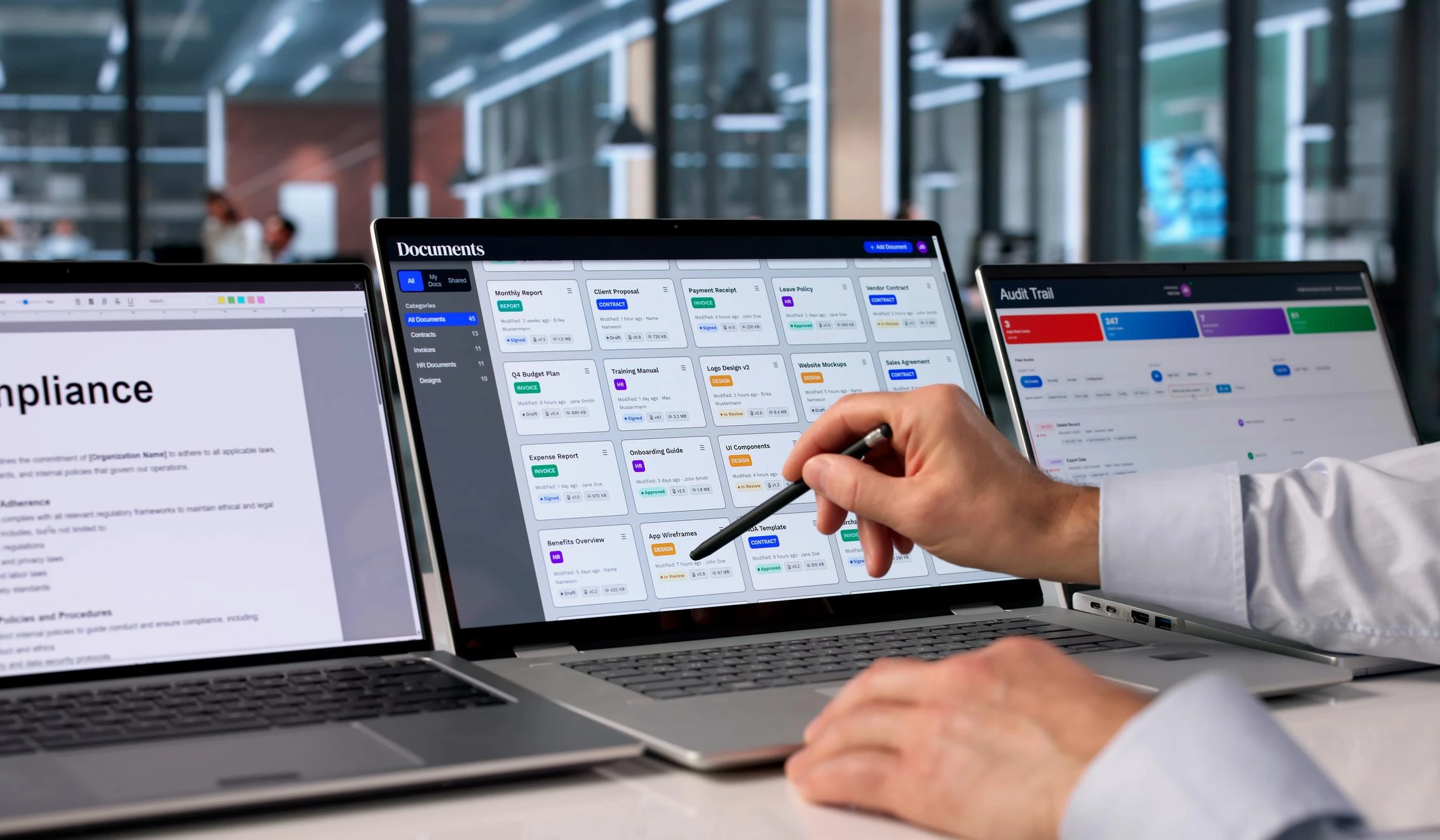
Versioning is one of the most important aspects of document repository compliance. You need to be able to provide the particular version of a document that is current at a certain time during an audit. The “most recent” file does not provide the history and proof of compliance. Older versions of documents are automatically archived and a clear, time-stamped audit trail is maintained to indicate when a document has been received, reviewed, and replaced.
Key Requirements for a Compliant Document Repository
A document repository or a Document Management System should have some basic technical and functional features to meet the stringent criteria of the auditing bodies in the modern era.
1. Centralized Accessibility with Role-Based Permissions
All compliance data should be accessible from anywhere, but not to everyone. A compliant system can enable a plant manager in one state and a corporate executive in another to see the same “source of truth. Document Compliance Network (DCN) offers a secure cloud-based solution that allows permissions to be customized so that sensitive documents, such as tax forms or insurance documents, can only be viewed by the appropriate stakeholders.
2. Automated Expiration Monitoring
As good as the content of the repository is. Automated “chase” engines are the smart, food-safe alternatives to manual storage. These engines record metadata on each file. The system should automatically start contacting the vendor to reorder the document if there are 60 days left to renew. DCN has expertise in this “friction-free” automation, taking date-tracking off the QA team’s plate.
3. Friction-Free Data Collection
The most difficult task for repository compliance is getting data into the repository in the first place. The process is difficult for the supplier – the repository will be incomplete. Suppliers can upload documents using a secure email link provided by DCN via its “no-login” links. This allows the repository to be filled rapidly and accurately and allows for 100% compliance documentation to be achieved much quicker than the traditional password-protected portals.
How DCN Ensures Repository Integrity
Document Compliance Network (DCN) was built specifically to solve the “missing paperwork” crisis in regulated industries. Our platform serves as a high-integrity vault for your most critical compliance records.
- Standardized Categorization: DCN organizes documents by vendor, type, and risk level, making it easy to filter and find exactly what you need during an unannounced inspection.
- Encrypted Security: All documents are stored using enterprise-grade encryption, protecting sensitive Personally Identifiable Information (PII) such as Taxpayer Identification Numbers (TINs) found on W-9 forms.
- Time-Stamped Approvals: Every document in the DCN repository undergoes a review process. Once a QA manager approves a file, the system logs the digital signature and timestamp, creating a defensible record for auditors.
The ROI of Compliant Document Repositories
Investing in document repository compliance provides a significant return on investment by reducing both “hard” and “soft” costs.
- Audit Speed: The time spent on-site by an auditor is expensive. A compliant repository allows you to pull a complete supplier profile in under 60 seconds, significantly shortening the audit duration and increasing the auditor’s confidence in your facility.
- Labor Efficiency: QA managers typically spend 10–15 hours per week on administrative document management. Automating this through DCN allows those highly skilled employees to focus on food safety culture and process improvements on the plant floor.
- Risk Mitigation: The cost of a single recall or a lawsuit involving an uninsured contractor can be millions of dollars. A compliant repository ensures that you are never caught without the necessary legal and safety protections in place.
Frequently Asked Questions (FAQ)
Q1. What does document repository compliance mean?
Ans: It is managing a digital storage system in such a way as to ensure that it is compliant with legal and regulatory requirements with respect to data security, version control, and accessibility, especially for audit data.
Q2. What is the difference between DCN and the normal cloud storage services, such as Google Drive?
Ans: Normal cloud storage isn’t “dynamic” and won’t keep track of expiration dates or email you for renewals. DCN is an ‘active’ repository built specifically for compliance, with automated vendor ‘chasing’ and audit-prepared reporting.
Q3. Do SQF or BRCGS audits need a compliant repository?
Ans: Although the technology does not have to be specified, the outcomes delivered by a repository that meets the requirements of the GFSI are crucial for earning high marks in audits that are GFSI-benchmarked.
Q4. What is DCN doing to ensure document security?
Ans: All data in DCN is encrypted both at rest and in transit. Our links for uploads do not require logging in, and are tokenized and secure, meaning that only the supplier intended to upload files to your repository can upload them.
Q5. Are there historical versions of documents that I can save?
Ans: Yes. When an older version of a document is uploaded, it will be automatically archived in the DCN system. This enables you to demonstrate compliance for any past date, satisfying the strict need for many auditors.
Q6. Can I be alerted to documents that are about to expire?
Ans: Yes, but, it also informs the supplier. The automated engine on DCN starts to send renewal requests to vendors when a document is due to lapse 30, 60 and 90 days prior to the actual date the document is scheduled to expire, keeping your repository up-to-date, even if you are not in the office.
Create your Defensible Audit Trail using Document Compliance Network (DCN).
In the world of regulatory oversight, however, if a document is not in your repository, then it doesn’t exist. Document Compliance Network (DCN) offers the infrastructure necessary to take it from the “file storage” mindset to document repository compliance. We designed our platform to remove the friction of suppliers having to submit documents and to be transparent and secure to meet auditors’ needs.
Break the cycle of last-minute audit preparation and experience the calm, confident, and “Closed” audit. From a single facility to a global supply chain, DCN makes documentation your strongest link in the compliance chain. Become one of the top companies that have taken the “less paperwork, more sales” approach. Don’t wait to see how Document Compliance Network (DCN) can help you future-proof your compliance.
- [post_views]
- 0 Comments